Welcome back to this journey through The Kolbrin.
So, we are currently working our way through The Sacred Registers; and this post will take a look at Chapters 19-24 which contain various hymns from the so-called Book of Songs which is, in turn, part of The Book of Scrolls (aka The Book of Books, The Lesser Book of the Sons of Fire, and The Third Book of the Bronzebook).
Some of the hymns we are about to take a quick look at, as well as others that follow, are fragmentary, and much within them is rather repetitive, so we will not dwell long in this area of The Kolbrin. That’s not to say, though, that there’s nothing of interest in these five short chapters, because there very much is!
The first thing we need to remark upon is that the setting for the hymns is very much an Egyptian one, with references to topographical landmarks (such as the Nile) and references to nature (such as reeds, locusts and crocodiles) confirming that we are looking through the scribes’ eyes at what was probably an early, possibly pre-dynastic period in that land’s past. The reason that I tend towards a pre-pharaonic era is because the The Kolbrin and its ‘Good Religion’ focus on the concept of a single omnipotent God, which is something that comes across very strongly in these passages.
The next thing to note is that in several passages of these so-called hymns there are references to some great disaster that ‘obscured the face of the sun’ from the fathers of the people who wrote these pieces. Although the generic term ‘fathers’ can mean anything from the immediately preceding generation to remote ancestors, other scattered comments in the hymns mention things like ‘hurricane winds’, floods sweeping the lands, and ‘sky boulders’, so are we looking at a racial memory of one of the periodic returns of the ‘Destroyer’ mentioned in previous chapters of The Kolbrin? Or are we looking at some other cosmic event, one that involved the sudden melting of the ice caps and a subsequent sea-level rise that resulted in widespread inundation. More and more evidence is coming to light that these planet-changing events happen more frequently than hitherto suspected, with some of them causing conditions in which so many particles are introduced into the atmosphere that the sun can, indeed, seem to become dim, or even be obscured completely.
Some food for thought there. Anyway, on with the hymns themselves:
So, in Chapter 19 we find A Hymn from the Book of Songs -1. It is a fairly standard paean to the Deity, lauding this One God for providing crops, reeds, and fish, managing the annual inundation of the waters, guiding the hands of the craftsmen, inspiring the artists etc. etc.
The reference to a time of disaster in this hymn comes when the God is credited with being the ‘Guide to our fathers in the sad days of darkness when the face of the sun was veiled in gloom from the eyes of men’. Now, that’s interesting enough, but then comes another very strange remark as the scribe thanks the deity’s ‘firm will’ which ‘holds stone in stability, so the great buildings endure through the ages.’
That bit’s for all of you out there who subscribe to the theory that the Great Pyramid and Sphinx have been around a lot longer than their supposed construction during the Fourth Dynasty to serve as a tomb for Khufu (Cheops) around 2580-2560 BCE. An awful lot of recent investigation into the interior of the Great Pyramid is beginning to suggest that it was never intended as a place of internment, rather its purpose seems to have been to serve a more scientific function. The newly identified (although disputed) ‘piles’ beneath the structure would also support this hypothesis. It’s all so damnably fascinating . . . but I digress.
The remainder of the hymn in Chapter 19 is standard fare. The deity is responsible for giving man justice and law, all men are equal at a basic level, the seasons are regulated by the divine will, the deity is compassionate and loving and is the One God hidden behind all those other gods to be found in the various temples (in other words, all gods are but facets of the One God). Chapter 19 ends with an entreaty by the scribe that mankind be shown the error of his earthy ways so that it may come at last into the deity’s safekeeping.
Chapter 20 contains A Hymn from the Book of Songs – 2. It is a very short passage, the tone of which is entirely unlike that of the preceding hymn. In this passage, it is the deity, specifically, who is credited with a wrath that ‘purges the land, even as it was done in the days of our fathers’ something the scribe says that ‘wayward and wilful’ humanity brought upon itself. So, this hymn’s a bog-standard account of the fall of man and how any wrecking of the planet is down to our own inability to toe the creator’s line. We’ve all heard that story before, haven’t we? It goes on that we are weak-minded and frail creatures and implores the deity to take this into account when dealing with us, please.
So, this would be a little passage that could essentially emanate from any one of a thousand other religious texts … except for one consideration. The third, and fourth sections of the hymn (I’d baulk at calling them verses) are very weird and don’t seem to fit thematically with the rest of the chapter.
In section 3, we are told that ‘the spirits of men rule in the mysterious domains governing the sun and the moon, the stars and the nightwatchers, the mistmen and the hidden caves of power. They undertake their appointed tasks there and are wave wanderers of the watery wastes, guardians of the deep’. As if that wasn’t eerie enough, section 4, speaking of man in general, informs us that the deity ‘has opened (humanity’s) ear to mysterious and wonderful things’ and that it has ‘revealed strange mysteries to his eye’ so that ‘he knows things unbelievable in olden times’.
‘Mistmen, nightwatchers, hidden caves of power,’ what’s all that about, then? I could gloss over the bit about knowing things unbelievable in olden times as a simple result of the march of progress as the ages pass, but I’ve the distinct feeling that those two passages – 3 and 4 – don’t really belong in this hymn, rather they are part of another passage with an altogether more esoteric message.
And so, on to Chapter 21 with its subtitle The Sunsetting Hymn from the Book of Songs. This is, again, a common-or-garden paean to the One God, lauding the deity for creating and providing all things, seeking protection from evildoers, and pledging to do good.
The Egyptian flavour is strong in this hymn too, with a nod to the ‘great mothering river’, but we also get a reference to a divine wrath that ‘lit up the vaults of Heaven’ with a fire that ‘devoured the wicked in olden times’ and, interestingly, a whirlwind that ‘swept clean the Earth’ along with a power that ‘lifted the seas and dashed them against the mountains’.
Now, the symptoms of the cataclysm that this hymn describes – fireball, fantastically strong winds, seas sloshing around in their basins – are exactly what would be expected in the immediate aftermath of a massive meteor or asteroid impact somewhere on the Earth. Again, could this be another reference to a visit of the ‘Destroyer’? More and more evidence is beginning to stack up that a major cosmic event wiped out much of human civilisation somewhere around 9,000 years ago (some say earlier, some later) so it’s worth posing the question whether that is what these hymns are referring to. If these pieces were authored somewhere around 4000 BCE (or earlier) they would be about the same temporal distance from this ‘global cataclysm’ as we are to the scribes who wrote the hymns. Worth having a think about, I’d say.
On a more spiritual note, Hymn 21 is very much in tune with the concept of a deity that is all-pervasive – omnipresent and in all things. It is a deity to which having its ‘likeness’ carved in wood or stone or wrought in metal means absolutely nothing. This deity is to be found not in a temple but in Nature; it is the power behind all things and does not require the insincere droning of corralled congregations.
But always in the back of the mind of the compiler of Hymn 21 is the fear that the destruction wrought on the ancestors will come again, and he imbues the deity with the power to prevent such a disaster from recurring. The God, he writes, is the only power that can ‘deflect the Awesome Ones of Heaven from their path of destruction . . .turn aside the skyboulders and break the winds of the hurricane’.
The scribe then goes on to list all the titles of his deity before finally petitioning it to be kind and patient with poor old struggling humanity which is groping in the darkness towards what little enlightenment it can discern.
Chapter 22 hedges its bets as far as a subtitle is concerned, being A Hymn or Prayer from the Book of Songs – 3. This passage is a plea for enlightenment and guidance in a life in which the entreater fears he (or she) is losing their way and falling into evil ways. It is a request for a bit of help from the deity, a sneak peak, as it were, into what the great secret of life is. If the veil between the worlds is lifted a tad, they say, maybe knowing a little about the magnificence beyond the divide will help steady the footsteps of those who falter during their earthly travails. Bit of a cop out, if you ask me. It would be like being given irrefutable evidence of life after death – as soon as people know that popping your clogs isn’t the end, everyone would give up trying on this side of the curtain.
On to Chapter 23, and this one’s got two subtitles: A Hymn from the book of Songs – 4 Marked: The Hymn of Rewa. This is my favourite one amongst the hymns in this section. It is joyful, it is optimistic, and it also smacks of esotericism.
The hymn-singer (Rewa?) is obviously an initiate of some degree, and the whole hymn, with its many formulaic lines, could well be one that was used as an invocation of sorts, perhaps to awaken within the chanter a state of transcendence to catch a glimpse beyond the veil.
It starts with an invitation for everybody to join in the dance: priests and priestesses, Skytravellers (the celestial luminaries – sun, moon, stars), even strangers. How inclusive and lovely! We are asked to dance around moonwise (counterclockwise) and stamp our feet on wickedness, hypocrisy, malice, and hatred. Flutes, pipes, and bells are summoned so that we can trample on pride and lust while ringed about by a protective shell of joyful and melodic music.
The singer announces that they are ‘one who rises over the fallen’ and then offers their credentials to the ‘All Seeing Power’ to which they are appealing. They own great strength, they say, are filled with the Sacred Essence and have drunk from the cup of joy. ‘I am pure, I am pure, I am pure,’ they intone, all of which declares that they have undergone ritual purification to ready themselves for the rite.
As their eyes are opened they see and acknowledge the attributes of the cardinal points: Love from the East, Benevolence from the South, Hope from the West, and Comfort from the North. As well as having definite echoes of Masonic rites, this is also in a way like the protective prayer of Saint Patrick’s Breastplate, designed to envelop the invoker in a cocoon of metaphysical armour.
Then the hymn-singer centres and stills themself. The powers they have summoned gather and the psychic energy builds (these are my words, by the way, The Kolbrin itself uses more poetic language but, in my opinion, it is describing the same thing). The initiate seeks to free the inner catch that will release them from all bodily sensations and negative emotions until they can perceive what is truly real.
Finally, the hymn-singer’s vision can pierce the veil, and their inner senses are awakened to the beauty of what really is. They perceive the soul-aching wonder of the eternal divine, they are finally free!
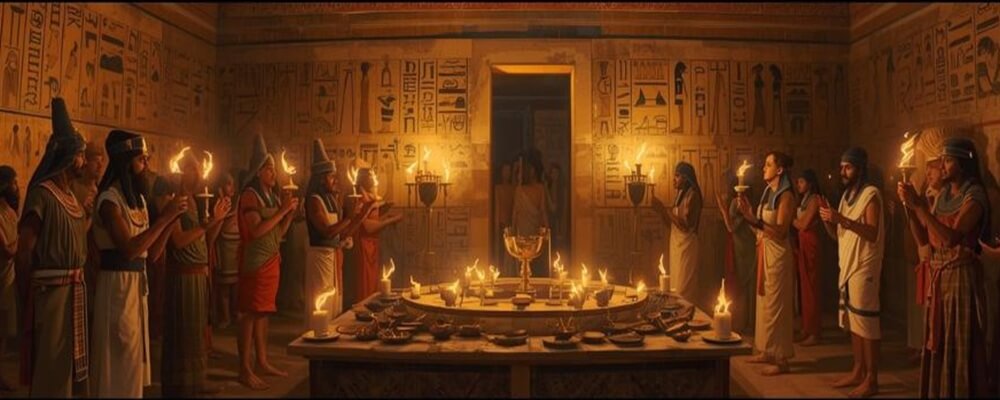
The hymn-singer/initiate has obviously passed the test as they now bow before the object of their veneration and proclaim loyalty to their fellows to the right and left. They see the ritualistic tools – meat, tripod, knife, flame, bowl – and invite the benevolent forces they have summonsed to gather around the offering while at the same time debarring any malevolent beings from the ritually conjured circle.
The now initiated hymn-singer is able to perceive the radiant beings that have torn aside the curtain between planes of existence, and invites their fellows to gaze upon them too, and join in the offering. ‘Bring incense,’ says the hymn-singer, ‘bring water, bring salt and bring the offering flame’.
Now, if that’s not a description of an initiatory ritual, then I don’t know what is!
The last hymn in this particular post is to be found in Chapter 24 and is subtitled simply A Hymn from the Book of Songs – 5. The Kolbrin itself admits that this passage is a bit hotch-potchy and likely composed of bits and pieces of more than one hymn, and it doesn’t contain much for us to get excited about, so I’ll skim it briefly.
The opening verses contain the usual adulation of the deity and acknowledgement of its omnipotence and omniscience, and the way it has guided the footsteps of men down the ages in love and beauty. It speaks, too, of the beauty beyond the veil.
The last few stanzas are a tad more esoteric, sounding more like something taken from the rituals of a particular sect. They speak of worshipping their deity from within the ‘Hidden Place’ and state that they bow to it ‘in humility, not in servility’ which is an interesting remark that, along with the lines straight afterwards, would suggest that the hymn-singers see their time on Earth as a learning and training experience, an opportunity to iron out any self-serving wrinkles before they reunite at death with the all pervasive force. In other words, while they exist in human form, they are ‘extensions’ of the divine, and life on Earth is some kind of ‘mechanism’ for the divine force to self-purify (which is a concept we have come across in other streams on the ancientselfhelp.com website, particularly on the Gurdjieff thread).
And that’s it for this set of hymns. There’s not an awful lot of self-help advice we can wring out of them, so I’ll settle for just reinforcing the message of Chapter 24 about using our time here on Earth for selfless pursuits.
There are some in this life who adhere to the Do as thou wilt shall be the whole of the law / Nothing is true, everything is permitted maxim, in which the attitude seems to be that as this temporary collection of molecules is all you’re ever going to get as an individual, you may as well enjoy yourself and do whatever the hell you want. Now, that’s an OK way of going about things as long as you doing whatever you want does not harm anybody or anything else. Sadly, though, self-indulgent people mostly have scant regard for the impact they and their actions have on others and often leave misery and destruction in their selfish wake.
When, however, we do something ‘good’ – we are kind and helpful towards others, we complete the tasks we set ourselves etc. – our bodies ‘reward’ us with ‘happy’ chemicals such as dopamine, serotonin, endorphins, and oxytocin. To my mind, that’s Nature (or the deity, or The Force, or whatever else you want to call a guiding power) giving us a nudge in the right direction. When we do something worthwhile, we get a reward. Now, you may think that makes it sound a bit like dogs being given a treat when they behave or do something right, but, in my opinion, that’s exactly what it is. The Multiverse, the All and Everything, actively wants us to behave in a certain way which – and this is the important bit – is good for it, and so we get ‘rewarded’ when our behaviour (or the type of energy behind the intent) is of the quality that the Multiverse actively needs for its own upkeep and continued existence.
OK, enough of the deep stuff. Chapter 25, which I’ll cover off in the next post is a collection of many short fragments, so I’ll deal with that soon before getting back to the meatier content of this part of The Kolbrin. I hope to see you there.